
The Best Core Exercises for Osteoporosis/Osteopenia
How to protect your spine!
If you’re like most people when asked about osteopenia or osteoporosis, your mind likely goes straight to the usual fix-it list:
💊 Medications
💉 Hormone therapy
☀️ Calcium and Vitamin D
💪 Lifting heavier weights
🦘 Maybe adding some jumping or impact work
And you’d definitely be right—those strategies matter!!
Especially resistance training and smart impact moves…they can stimulate bone growth and help protect your skeleton.
But when I start working with a woman in perimenopause to post-menopause with low bone density, my trainer brain goes somewhere else first.
👉 I think about her CORE.
Not for six-pack abs.
Not for aesthetics.
But for protection.
Because when estrogen decline and bones become more fragile, it’s not just about building density—it’s about preventing fractures.
And many of the most devastating fractures in midlife and beyond happen in the spine.
Why This Matters
Not one solution on its own is adequate to ensure your bones are healthy and strong well into your golden years. Building a healthy skeleton involves a multi-dimensional approach, including some often-overlooked solutions—like training your core—that have a massive impact on your bones.
FITNESS SIMPLIFIED
Your core muscles — the deep stabilizers that wrap around your abdomen and support your spine — act like a built-in brace.
And a well-functioning brace is key to an active independent life.
Fitness Tip to Build Strong Bones
Strengthen Your Core
A strong, responsive core helps you maintain posture, resist excessive spinal flexion, and move through daily life without putting unnecessary strain on vulnerable vertebrae.
And as you train your core muscles, you’re even stimulating the bone cells in your spine to grow and become stronger.
In other words: a strong core isn’t just about aesthetics.
👉 It’s about stability.
👉 It’s about safety.
👉 It’s about building a strong spine.
👉 It’s about staying upright, independent, and confident in your body for decades to come.
With strength comes confidence to move and be active in your everyday life.
The video below has the best targeted exercises to strengthen your core.
Try these today and work them into your regular routine. You won’t regret it!
Best CORE Exercises for Spinal Osteoporosis or Osteopenia
- Best CORE Exercises for Spinal Osteoporosis or Osteopenia
- Pelvic Tuck + Exhale (6 deep breaths): Improves core strength in the deepest layers
- Side Planks (30 sec hold/side): Modify with your knees on floor if needed or fully extended if able
- Regular Planks (30 sec hold/side): Improves bracing strength for your spine
Extra Tip: These core exercises can be practiced daily. Do this as a circuit of exercises, starting with one set through and gradually building up to 3 total sets.
Did You Know...
- Fractures from osteoporosis occur most often in the spine and happen an estimated 1.5 million times a year. Spinal fractures are almost twice as common as other osteoporotic fractures (e.g. the hip or wrist).
- Weakened vertebrae (largely due to a weak core) contribute to a hunched posture, loss of height, and a higher risk of spinal fractures as we age.
- Movements with your trunk—such as forceful or loaded twisting, arching and rounding—can be riskier for weakened vertebrae. Building a strong core provides a strong, stable structure around the spine to significantly reduce risks of fractures.
NUTRITION SIMPLIFIED
Of course, we can’t talk about strengthening our bones without talking about the mineral that does much of the heavy lifting—calcium.
Nutrition Tip to Build Strong Bones
Consume Adequate Calcium
Calcium isn’t just important for building strong bones and teeth.
It also plays a critical role in muscle contractions, nerve signaling, and heart function.
Here’s what matters for us in midlife:
👉 When estrogen declines during perimenopause, our bodies become less efficient at maintaining bone density.
💡 That means our calcium needs become even more important.
Most women over 40 need about 1,000 mg of calcium per day, increasing to 1,200 mg after 50.
The key?
Getting as much as possible from food first.
Strong bones aren’t built by one nutrient alone—but without adequate calcium, the foundation simply isn’t there.
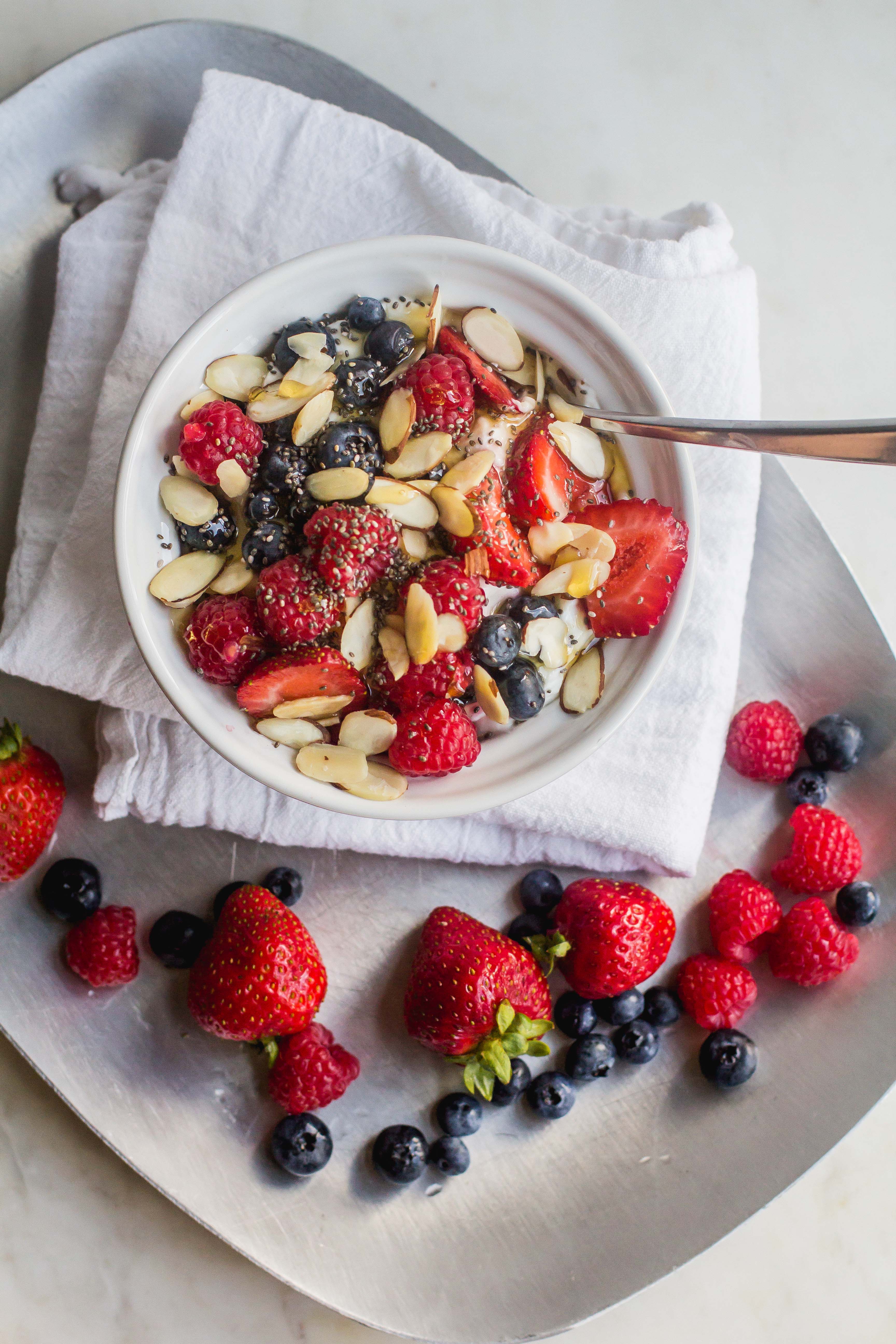
Try this yummy breakfast bowl to kickstart your calcium for the day.
Yogurt & Berry Breakfast Bowl
More ideas to Prioritize Calcium:
- Swap in cottage cheese for your yogurt bowl or make it savory with avocado and salsa
- Leafy greens like kale and bok choy pack a calcium punch and make a great addition to stir-frys
- Add sardines or canned salmon to a salad for another calcium dose
MINDSET SIMPLIFIED
With fitness and nutrition—especially in midlife—try shifting your focus away from aesthetics and toward health.
The real value runs much deeper than how your belly looks in a pair of jeans or a swimsuit.
Some of the most powerful results of your health efforts will never be visible in the mirror.
But you WILL feel them in your strength, your stability, and your independence…
…and that’s what truly matters!
Mindset Tip to Build Strong Bones
Focus on Longterm Health Most
THE TAKEAWAY
Every time you strengthen your core and nourish your body with calcium-rich foods, you’re doing something far more meaningful than chasing a smaller waistline. You’re reinforcing your spine. You’re protecting your posture. You’re reducing fracture risk. And you’re building a body that can carry you confidently into your 60s, 70s and beyond.
- Strengthen Your Core
- Consume Adequate Calcium
- Focus on Longterm Health Most
ADDITIONAL RESOURCES
Self Care Simplified podcast
SELF CARE SIMPLIFIED PODCAST EP 268. Increase Bone Density and Prevent (and Reverse!) Osteoporosis
SELF CARE SIMPLIFIED PODCAST EP 354. Osteoporosis & Bone Loss in Women - The Tips You Need NOW
SELF CARE SIMPLIFIED PODCAST Nutrients: Why Food Is More Than Calories
SPECIAL RESOURCE
Ready to add more exercises to your core training plan? Follow along as I work out with you. Pay close attention to the cues to make sure your core is stable and engaged.
Core Workout For a Stronger Spine
Until next week... Be strong
